
How infrastructure can be effectively integrated into pension fund portfolios, and why the right fund structure plays a key role in this process.
Private infrastructure has become an indispensable part of many institutional investors' portfolios. Swiss pension funds and other retirement plans seek stable, long-term cash flows, diversification and a certain degree of protection against inflation. This is exactly where infrastructure projects really shine. The question is increasingly less "Should we have infrastructure? " and more "What kind of infrastructure?"
From closed-end to open-end funds—a market in transition
Initially this asset class was dominated by traditional closed-end structures modeled after private equity: fixed term, fundraising phase, capital calls and a subsequent holding and realization phase. For large investors with extensive resources and a strong focus on investment efficiency, this model has long been the preferred choice.
In recent years, demand for open-end structures has increased significantly. Smaller investors, in particular, who have limited capacity for ongoing cash and commitment management, value evergreen approaches: subscribe, quick investment, defined redemption options. However, certain open-ended private-market products—particularly in the private credit sector—came under pressure at the beginning of this year when redemption requests could not be fully met and gating clauses were triggered. The commingling of institutional and retail client funds is viewed as particularly problematic, as it can make liquidity management even more difficult.
However, these examples should not be interpreted as a general argument against open-end structures or infrastructure projects, but rather as a reminder: The underlying investments remain illiquid—regardless of whether they are held in closed-end or open-end funds. Investors should therefore have a clearly defined illiquidity budget and an appropriate risk tolerance before committing to private market investments.
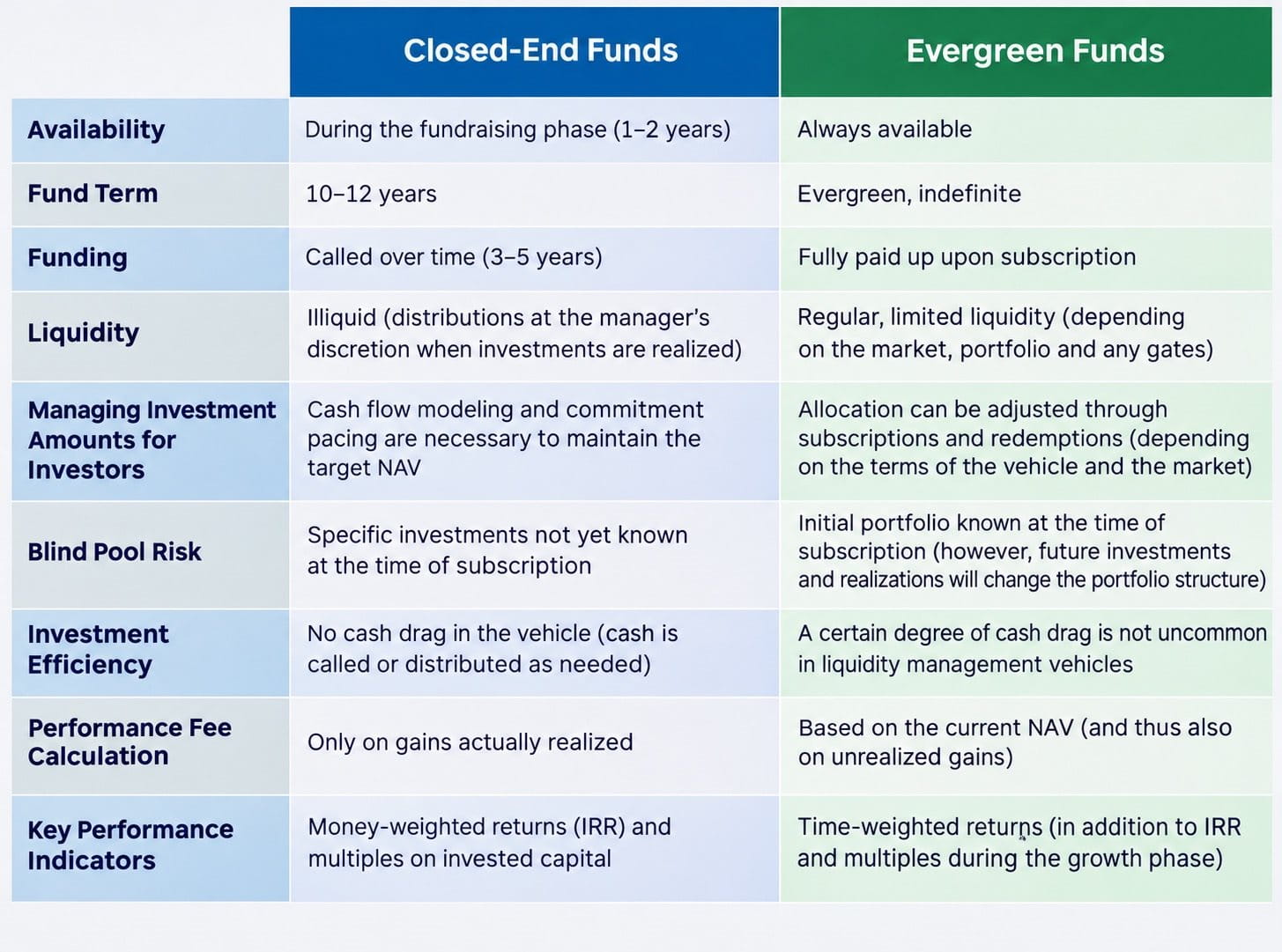
Closed-end funds: clear life cycle, high efficiency
Closed-end infrastructure funds follow a familiar pattern: build-up phase, holding phase and realization phase. Capital is drawn down over several years, invested and later returned through distributions and exits.
Strengths of this structure:
- high investment and asset efficiency
- no dilution by subsequent investors
- generally lower ongoing structural costs
- strong governance and defined exit strategies
- performance fees are usually based only on realized gains
In return, closed-end funds require active cash management, planning of capital calls and clear reinvestment decisions when proceeds are received.
Open-end funds: ongoing allocation, managed liquidity
Open-end or evergreen funds do not have a fixed term. They invest in an existing portfolio, accept capital on an ongoing basis and offer redemptions with defined time frames. The level of investment tends to rise quickly, and the blind pool risk is lower than that of a newly launched closed-end fund.
Typical benefits:
- continuous build-up of an infrastructure portfolio
- rapid investment of capital in ongoing projects
- reduced operational effort in cash and commitment management
- ongoing management of the infrastructure allocation through subscriptions and redemptions
Structural choices amid the tension between the market and governance
Structures are not "good" or "bad" in and of themselves. The key factor is how well they suit the investor. For some pension funds, clearly defined investment horizons, exit strategies and investment efficiency are the top priorities—they tend to favor closed-end funds. Others place greater emphasis on convenience, ongoing allocation management and lower operational complexity—in these cases, open-end funds appear more attractive.
Larger institutional investors are increasingly combining both approaches: closed-end funds for the targeted exploitation of illiquidity premiums, vintage-year diversification and governance; open-end funds for smoothing the investment path and more finely adjusting the infrastructure allocation over time.
Conclusion: an attractive asset class with a carefully chosen structure
Infrastructure remains a compelling asset class: long-term, often inflation-linked cash flows, low correlation with traditional asset classes, robust diversification and exposure to key transformation processes such as the energy transition and digitalization are clear arguments in their favor.
Those who are aware of the illiquidity of the underlying investments and consistently align their choice of structure with their own objectives, the regulatory framework and governance can establish infrastructure as a stable and valuable component of their institutional portfolio—regardless of whether they use closed-end, open-end structures or a combination of both approaches.