
Infrastructure investments between state security and political unpredictability – what should investors look out for?
The global political landscape is changing: In addition to geopolitical crises, the increasing polarization of politics can be observed. More and more frequently, new governments are differing fundamentally from their predecessors, be it in their economic priorities, regulatory approaches or support programs. For the financial markets, this means that predictability and stability are by no means a given.
What makes infrastructure so attractive from an investor's point of view?
Infrastructure investments are generally linked to the basic needs of society, provide predictable cash flows and offer natural protection against inflation. They also often have high entry barriers and little competition. For institutional investors with a long-term investment horizon, these are powerful arguments – especially when the financial markets become more volatile.
State regulation in the infrastructure market – another advantage
Another positive aspect for investors is that many infrastructure investments are secured by the state or regulatory authorities:
- Regulated returns: Water or electricity suppliers often operate in markets in which a regulator sets the permissible tariffs. British water companies, for example, receive predictable, politically determined returns. This creates stability for investors.
- Regulatory protection: Some assets benefit from legal protection mechanisms, e.g. an airport operator that is not allowed to have any competitors within a radius of 100 kilometers. Such monopoly situations offer reliability.
- Direct subsidies: Feed-in tariffs, tax credits or one-off investment grants are key sources of income, particularly in the field of renewable energies, and open up access to new technologies.
Why does the state intervene?
State guarantees and regulations serve the public sector by enabling the private financing of central infrastructure. At the same time, security of supply and price stability need to be guaranteed – especially in monopoly-type markets. For investors, this means a calculable environment and a degree of protection against market risks. As a rule, political influence ensures stable, predictable framework conditions – in exceptional cases, however, new political circumstances can pose challenges.
Risks: When the wind shifts
The downside of state protection is political and regulatory risks: Changes in government can lead to changes in direction, cuts or even the withdrawal of existing subsidies.
- Spain: Retroactive subsidy cuts – a warning
In Spain, generous feed-in tariffs for renewable energies were massively reduced in the course of the 2012/13 financial crisis. This happened retroactively and with serious consequences for investors and operators. The events led to many years of legal disputes and partial losses. - USA: IRA Tax Credits and "One Big Beautiful Bill Act"
The Inflation Reduction Act (IRA) massively expanded tax incentives for renewable projects such as solar, wind and battery storage. In 2025, the US government launched "One Big Beautiful Bill" (OBBA), which limits the duration of some of these incentives and/or attaches conditions to them.
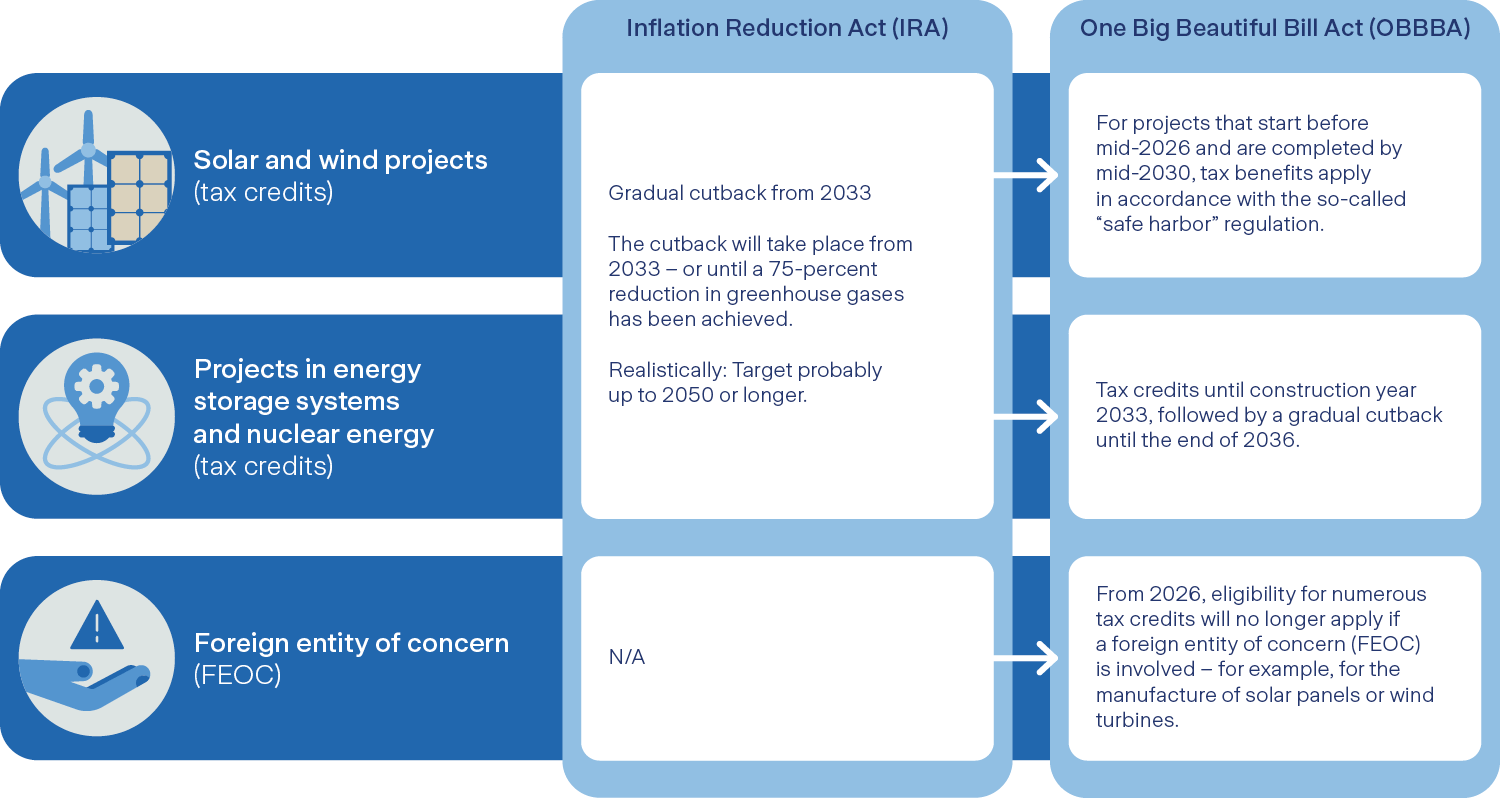
Such examples clearly show that political risks should not be underestimated, even in established markets.
What can investors do?
Despite attractive framework conditions, infrastructure harbors both risks and opportunities. The following strategies help to minimize political cluster risks:
- diversification across countries and sectors
- a focus on projects that are also viable without state subsidies
- solid deal structuring with a high proportion of long-term fixed contractual income with counterparties with strong credit ratings
- avoidance of particularly volatile or politically unstable regions
Conclusion: Infrastructure remains attractive – in moderation
Infrastructure investments have proven to be a valuable portfolio building block thanks to their defensive characteristics, low correlation to traditional asset classes and their potential for stable, inflation-protected returns – even in politically turbulent times. Nevertheless, they require careful consideration and intelligent diversification. Those who take risks into account during structuring, who actively monitor regulatory and political developments, and who rely on solid structures can not only achieve attractive returns with infrastructure, but also give their portfolio the stability they are looking for.